Circle of Candor | Living Magic with Juju 🦋
For a long time, the economy felt like something people argued about on the news. Numbers. Charts. Headlines that didn’t have much to do with my day-to-day life — or so I thought. Back then, I didn’t have language for it. I just knew what it felt like to need something and not have it. To make choices that weren’t really choices at all. To learn survival early, without realizing that’s what I was learning.
The truth is, the economy stopped being abstract for me a long time ago. It became personal the moment I had to figure things out on my own — before I was ready, before I was protected, before anyone explained how any of this was supposed to work. Money wasn’t a concept. It was shelter. Food. Safety. Or the lack of it. It showed up in the way I learned to calculate risk, in the way I learned to stretch what wasn’t enough, in the way I learned not to ask for things I already knew I couldn’t afford.
I didn’t grow up thinking in terms of financial systems or structures. I grew up thinking in terms of survival. What could be paid this month. What would have to wait. What I could carry alone without letting it show. I learned early that stability wasn’t guaranteed — it was something people either had or didn’t, and I wasn’t sure which side I was on.
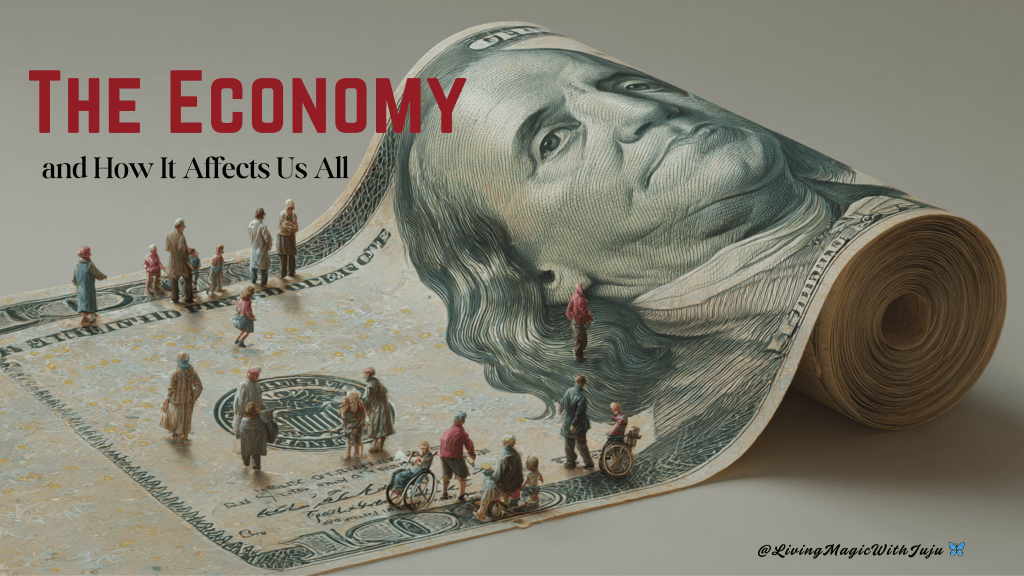
It took years for me to realize that what I was navigating wasn’t just personal hardship. It was a system I had been moving inside of without a map. One that rewards endurance and quietly punishes those who don’t have room to fall, rest, or recover. One that teaches you how to survive long before it teaches you how to live.
This isn’t an article about blame. It’s not about policies or politics or pointing fingers. It’s about noticing. About naming the moments when the economy stopped being a theory and became something I carried in my body, my decisions, my fear, and my exhaustion. About tracing the quiet ways it shapes a life — not all at once, but over time.
Because once you see it, you can’t unsee it. And for me, this is where that seeing began.
When Survival Starts Early
Learning safety before stability. Money as protection, not possibility.
I didn’t learn about money in classrooms or through advice.
I learned it through fear.
I learned it while running from harm, not toward freedom, not toward opportunity, but away from what was unsafe. I learned it in moments where stability wasn’t a goal. It was a question mark. Where shelter could disappear. Where food wasn’t assumed. Where safety depended on silence, endurance, and not asking for too much.
Money showed up early in my life as something tied to survival, not possibility. It wasn’t about saving or planning or building. It was about whether there would be enough to get through the next day. Whether staying quiet was safer than speaking up. Whether accepting what was offered, even when it came with conditions, was better than having nothing at all.
That kind of learning leaves a mark.
When survival starts early, it rewires how you see everything that comes after. Work doesn’t feel like growth. It feels like protection. Stability doesn’t feel like comfort. It feels fragile, temporary, easy to lose. Rest doesn’t register as necessary. It registers as dangerous, like something you earn only after proving you can endure.
I didn’t grow up believing that systems were meant to support people. I grew up believing that you had to navigate them carefully, quietly, and without complaint. That help came with strings. That needing too much made you a problem. That safety was conditional, and it could be taken away if you misstepped.
So I learned to be alert. To calculate risk instinctively. To measure my worth by how little I needed, how much I could tolerate, how well I could survive without drawing attention to the cracks.
Even later, long after the immediate danger passed, those lessons stayed with me. They shaped how I approached work. How I understood money. How I defined stability. How I carried fear in moments that were supposed to feel secure.
Because when survival is your first teacher, you don’t just outgrow it.
You carry it forward, quietly and faithfully, into every system you enter afterward.
And for a long time, I didn’t even realize that’s what I was doing.
Disability and the Cost of Trying
When progress becomes risky. Help tied to appearing broken.
I did not enter disability because I stopped wanting to work. I entered it because my body decided for me.
When the accident happened, everything about effort shifted overnight. I went from being someone who worked, who pushed through, who tried to build forward, to someone who had to explain why I could not. The questions changed. The expectations changed. Even the way people looked at me changed.
Disability was not relief. It was containment.
At first, I believed it was temporary. A pause meant to hold me until I could stand fully again. I believed that effort would be met with understanding, that improvement would bring more stability, that trying would count for something. I thought the system would recognize forward movement and meet me with support.
That is not how it works.
What I learned slowly is that help only exists when desperation is visible. The moment improvement appears, the moment adaptation happens, the moment life looks slightly more stable from the outside, support begins to thin. The message is rarely spoken directly, but it is unmistakable. If I am doing better, I should be able to manage. If I am surviving, I must not need as much help.
Progress becomes something to defend.
Trying carries consequences.
Earning slightly more risks losing everything. Functioning better invites more scrutiny. Surviving with composure creates the assumption that support is no longer necessary. The system does not grow with you. It measures you against thresholds that do not account for reality.
This creates impossible choices. Healing comes with risk. Stability feels conditional. Growth threatens the very support meant to make growth possible.
Disability did not just limit income. It reshaped how I relate to progress itself. I learned to move carefully. I learned to measure improvement instead of celebrating it. I learned to hesitate before hoping too loudly because hope could cost me the ground beneath my feet.
The cost was never only financial. It settled emotionally and psychologically. Healing became something to manage instead of embrace. Momentum became something to fear instead of trust.
I did not stop wanting more out of life. I learned that wanting more came with penalties. That dignity disappeared the moment I no longer looked like a crisis. That surviving quietly was safer than reaching visibly.
Those lessons do not stay contained inside disability. They follow you. They shape how you approach every system afterward, especially the ones that claim to be there to help.
The Quiet Trade-Offs Nobody Sees
What scarcity takes without being counted. Living inside shrinking margins.
Most of what the economy takes from me never shows up on paper.
It happens quietly, month by month, decision by decision, in the small calculations that never get named as loss. It looks like numbers, but it feels like restriction. It feels like narrowing. It feels like learning how to live inside a shrinking perimeter.
Every month begins with math. Not planning, dreaming, or building. Just accounting. What must be paid. What can be delayed. What will have to wait again. There is no flexibility in it. The money comes in and already knows where it is going before I ever touch it.
There is usually one good week. The week where groceries are stocked. Where gas does not feel urgent yet. Where I can breathe a little without counting every mile or every dollar. That week carries the illusion of normalcy. It looks like stability from the outside.
Then the rest of the month arrives.
Choices close in quickly after that. Outings stop. Spending tightens. Everything becomes measured. Gas is rationed. Food is stretched. Errands are planned around what absolutely cannot be postponed. Life becomes smaller, not because I want less, but because the margin disappears.
What gets lost is rarely acknowledged. Celebrations are skipped. Birthdays pass quietly. Holidays shrink into survival days. Experiences become luxuries. Even rest begins to feel indulgent, something that must be justified instead of something that should be allowed.
The hardest part is not the lack itself. It is the constant awareness required to manage it. Every decision carries weight. Every expense feels consequential. There is no room for error. One misstep can unravel the entire month.
This kind of living changes how I relate to time. I do not plan far ahead because the future feels unstable. I plan in increments. In weeks. In days. Sometimes in hours. I learn to stay close to the present, not out of mindfulness, but out of necessity.
What outsiders often miss is that this is work. Invisible work. Emotional work. Cognitive work. The labor of surviving carefully, of staying afloat without safety nets, of constantly adjusting expectations to match what is possible.
The economy does not just limit what I can buy. It reshapes how I move through the world. It trains me to contract. To pause before wanting. To calculate before hoping. To live with the understanding that comfort is temporary and security is conditional.
None of this shows up in job titles or bank statements. But it shapes everything.
Housing, Stuckness, and Containment
What it means to want to leave but not be allowed to. How money traps people in unsafe places.
There is a specific kind of stuckness that comes with housing. It is not just about where you live. It is about what you are able to escape and what you are forced to endure.
I have known what it feels like to want to leave a place and realize that wanting is not enough. That safety is not the deciding factor. That peace is not the deciding factor. That money is.
Housing is often talked about as a choice. As mobility. As something you upgrade or change when it no longer fits your life. That has not been my experience. For me, housing has often felt like containment. Like staying put not because it is healthy, but because leaving would cost more than I can afford.
There were times when the space I was in did not feel safe emotionally or physically. Times when the environment itself contributed to stress, fear, or harm. Wanting out was constant. Leaving was not an option. The math never worked.
What made it impossible was how the math had changed. It was no longer just first and last month’s rent. Every adult moving in needed an application. Every application came with a fee. Income had to be proven at three times the rent, sometimes before utilities were even counted. The expectation was not just to afford the space, but to overqualify for it. To demonstrate a level of financial margin I simply did not have.
Then the costs expanded further. Houses came with the expectation that tenants would carry everything. Rent. Utilities. Water. Sewer. Trash. Maintenance responsibilities shifted quietly onto the person renting. It began to feel less like housing and more like absorbing someone else’s risk. Paying into a structure I did not own, while carrying nearly all of the responsibility for it.
For me, living on disability, this became a wall. I could sometimes save enough for deposits if I planned carefully. But I could not change my income to meet a formula designed for households with multiple earners. Wanting to leave was not enough. Even preparing to leave was not enough. On paper, I did not qualify to be safer.
So I stayed.
Not because it was acceptable or it was chosen. But because survival required it.
This is how money traps people in places that hurt them. Not dramatically. Quietly. Through logistics. Through requirements that assume everyone has reserves, backup plans, or someone to catch them if they fall. Through systems that treat housing as a transaction rather than a foundation for safety.
When you cannot leave, your world shrinks. You learn how to cope instead of how to escape. You manage harm instead of removing yourself from it. You adapt to conditions that should not be endured simply because there is nowhere else to go.
I have felt the weight of that containment. The way it seeps into the body. The way it affects sleep, decision making, and hope. Knowing that relief exists somewhere else but remains unreachable creates its own kind of exhaustion.
Housing instability does not always look like homelessness. Sometimes it looks like staying. Staying longer than you should. Staying past what is healthy. Staying because the alternative feels more dangerous than the current situation.
That reality does not show up in statistics easily. But it shapes lives. It shapes how long people remain in unsafe relationships, unsafe environments, unsafe dynamics. It shapes how trapped someone can feel while technically still having a roof over their head.
I am not speaking about this from theory. I am speaking from memory. From lived moments where leaving was necessary but impossible. Where money made the decision before I could.
Housing, for me, has often been less about shelter and more about limitation. A reminder that freedom is not equally accessible. That safety can be conditional. That sometimes the hardest part is not knowing you need to leave, but knowing you cannot.
What It Does to Families
Children carrying adult burdens. Dreams delayed. Joy rationed.
The economy does not stay contained within adults. It moves through families. It settles into homes. It shapes childhood in ways that are not always visible from the outside.
I have seen what it does to children when adult concerns become part of their daily awareness too early. When they learn to listen for stress in a parent’s voice. When they understand, without being told, that certain things are off limits. When they stop asking for what they want because they already know the answer.
There is a quiet transfer that happens. Worry moves downward. Responsibility follows. Children begin to carry emotional weight that does not belong to them, not because anyone places it on them deliberately, but because survival requires transparency. Because pretending everything is fine is harder than admitting that it is not.
Dreams shift in that environment. They do not disappear. They get postponed. Hobbies become optional. Aspirations are put on hold. Joy becomes something scheduled carefully, measured against what can be afforded without causing harm elsewhere.
I have watched how celebration becomes strategic. Birthdays simplified. Holidays adjusted. Experiences weighed against bills. Not because love is absent, but because resources are limited. Joy is still there, but it is rationed. Saved for moments that feel safe enough to spend it.
This kind of living teaches children awareness early. It teaches them consideration. It teaches them how to be careful with hope. Those lessons look like maturity from the outside. Inside, they can feel like pressure.
I have felt the tension of wanting to protect children from worry while knowing that reality will reach them anyway. Wanting to give more while working within limits that do not bend. Wanting their memories to be full without pretending that scarcity does not exist.
The economy shapes family life not only through what is missing, but through what is delayed. Through what is adjusted. Through what becomes normal before it should have to.
These are not failures of love or effort. They are adaptations. Quiet ones. Made daily. Often without recognition.
And they leave their mark.
The Emotional Economy
The cost that doesn’t show up on paper: anxiety, shame, exhaustion, hypervigilance.
There is a cost to living this way that never appears in budgets or bank statements. It shows up emotionally. Quietly. Persistently. It becomes part of how I move through the world.
Anxiety is the most obvious one. Not the dramatic kind. The constant kind. The kind that lives under decisions and never fully turns off. It shows up when I open mail. When numbers change. When plans feel uncertain. Even when nothing is immediately wrong, my body prepares for the possibility that something could be.
Shame follows close behind. Not because I have done something wrong, but because scarcity has a way of feeling personal. It can make limitation feel like failure. It can make asking for help feel like exposure. It can make survival feel like something that needs to be explained or defended.
Exhaustion is always present. Not just physical tiredness, but mental fatigue. The kind that comes from constant calculation. From managing risk. From making sure nothing slips through the cracks because there is no margin for error. Rest does not fully restore when the system that demands vigilance never pauses.
Hypervigilance becomes a baseline. I notice shifts quickly. I track changes instinctively. I stay alert even during calm periods because calm has not always lasted. This awareness is not a choice. It is a learned response to instability over time.
None of this shows up on paper. It does not get counted. It does not qualify for assistance. It does not fit neatly into explanations. But it shapes daily life as much as any bill or balance ever could.
I carry this emotional economy alongside the financial one. Both require management. Both require energy. Both demand attention.
What makes this especially heavy is that it often goes unnamed. People see outcomes without seeing the internal cost. They see functionality without seeing the effort it takes to maintain it.
This is not about weakness. It is about exposure. About living in conditions that require constant emotional labor to stay afloat.
The economy does not just determine what I can afford. It determines how safe I feel. How much I rest. How freely I breathe. How carefully I hope.
That cost is real, even if it never appears on a statement.
The Myth of Hard Work
Why effort is no longer a guarantee. Why “try harder” has become gaslighting.
I grew up believing that hard work led somewhere. That effort accumulated. That if I showed up consistently, did what was asked of me, stayed responsible and persistent, stability would eventually follow.
For a long time, that belief carried me. It gave meaning to sacrifice. It made endurance feel purposeful. It allowed me to tell myself that the struggle had an endpoint.
What I have learned instead is that effort no longer guarantees safety.
I have worked hard in ways that are not always visible. I have adapted. I have complied. I have pushed through pain, fatigue, and limitation. I have followed rules that changed without warning. I have done what was required to survive within the systems I was placed inside.
Still, progress has remained fragile.
The gap between effort and outcome has widened. Trying harder does not always lead to improvement. Sometimes it leads to burnout. Sometimes it leads to scrutiny. Sometimes it leads to losing what little stability was already in place.
When people say “try harder,” it often ignores context. It assumes equal starting points. It assumes equal access. It assumes that effort exists in a vacuum, untouched by health, income limits, caregiving responsibilities, or systemic thresholds.
For someone like me, living on disability, effort is not absent. It is constrained. There are limits to what pushing forward looks like when pushing too far can cost support, health, or safety. Hard work does not disappear in those conditions. It just stops being rewarded.
Over time, being told to try harder begins to feel like being told that my reality is invalid. That if I am still struggling, it must be because I am not doing enough. That the system is neutral and the responsibility rests entirely on me.
That message erodes trust. Not just in institutions, but in myself.
I know how much effort my life requires. I know how carefully I manage what I have. I know the energy it takes to stay afloat. When that labor is dismissed, it creates a quiet kind of harm.
Hard work has not lost its value. But it has lost its promise.
Recognizing that has been painful. It means letting go of a story that once made survival feel meaningful. It means acknowledging that effort alone cannot overcome structures that are not designed to flex.
This is not about refusing responsibility. It is about naming reality.
Trying harder is not a solution when the ground itself is unstable.
Who Gets Blamed
How the system shifts responsibility onto individuals. Why judgment replaces understanding.
When things become difficult, blame tends to move downward. It lands on individuals rather than on the conditions surrounding them. I have felt that shift happen quietly, often without words being spoken.
Struggle is frequently framed as a personal failure. If someone cannot keep up, it is assumed they did not try hard enough. If stability slips, it is treated as poor decision making. If someone remains stuck, it is viewed as complacency instead of constraint.
I have experienced how quickly context disappears in these moments. Health is overlooked. Access is ignored. History is erased. What remains is a simplified story where effort is the only variable that matters.
Judgment replaces understanding when systems are treated as neutral. When outcomes are viewed without examining the terrain people are navigating. When survival strategies are mistaken for character flaws.
I have noticed how easily responsibility is individualized. Bills become moral markers. Housing becomes proof of worth. Productivity becomes a measure of value. The quieter realities of limitation and constraint are rarely acknowledged.
This kind of blame isolates people. It discourages honesty. It makes asking for help feel dangerous. It teaches people to hide their struggles rather than speak about them, because being seen as incapable can carry consequences.
I have learned to be careful about what I share and with whom. Not because I lack insight, but because insight is not always met with empathy. Too often, it is met with advice that assumes options I do not have.
What gets lost in this process is nuance. The understanding that systems shape outcomes long before individuals are judged for them. The recognition that many people are doing everything they can within limits they did not choose.
Blame simplifies reality. Understanding complicates it.
Living inside this economy has taught me how quickly compassion disappears when difficulty is misunderstood. It has also taught me how necessary it is to name that shift, especially before concluding that struggle is a personal failure.
As I approach the end of this reflection, I am aware that blame thrives in silence. Understanding begins when lived experience is allowed to speak without being corrected.
That distinction matters.
Closing Reflection
Not a solution. Not a demand. Just a truth spoken clearly.
I am not writing this to offer answers. I am not writing this to fix anything. I am writing it to tell the truth as I have lived it.
This has never been about laziness. It has never been about a lack of effort, motivation, or responsibility. It has been about endurance. About how long someone can carry weight without relief. About how much strain can be absorbed before exhaustion becomes visible.
I have endured carefully. Quietly. Repeatedly. I have adjusted my expectations. I have narrowed my needs. I have learned how to survive within limits that did not loosen with effort. I have done this without spectacle, without complaint, without assuming anyone owed me understanding.
What I have come to see is that the system does not reward endurance. It relies on it. It expects people to keep going without rest, without margin, without certainty. And when fatigue finally shows, it treats that fatigue as failure.
I have felt that disconnect deeply. The gap between what is required and what is possible. The way tiredness becomes something to explain instead of something to acknowledge. The way survival is mistaken for insufficiency.
This reflection is not about blame. It is about clarity. About naming what happens when people are asked to endure indefinitely and then judged for the wear it causes.
I am not asking to be rescued. I am not asking to be excused. I am naming what is real in my body, my choices, my life.
This is where I am, what I have learned, and the truth I carry forward.
I don’t write this to accuse or demand change. I write it to name something that has lived quietly alongside me for years. Something that shaped how I measured myself. How I rationed hope. How I learned to endure without expecting relief. I did not always recognize it for what it was. I thought it was personal. I thought it was weakness. I thought it was something I should be able to outgrow.
Seeing the pattern did not suddenly make life easier. It did not change my circumstances. But it did soften something important inside me. It loosened the reflex to blame myself for being tired. It gave language to what I had been carrying without context. It allowed me to see that much of what I survived was not a failure of effort, but a response to constraint.
What I am taking with me from this reflection is not an answer, but a steadier understanding. The ways we learn to survive do not disappear just because time passes. They settle into the body. They shape expectations. They influence what we believe we are allowed to want. Naming that does not erase the cost. But it does return some dignity to the experience of having carried it.
This is not the end of the conversation. It is simply a pause. A moment of honesty. A choice to hold my story with clarity instead of judgment.
With presence, patience, and a commitment to truth,
~ Juju

 livingmagicwithjuju
Leave a comment